

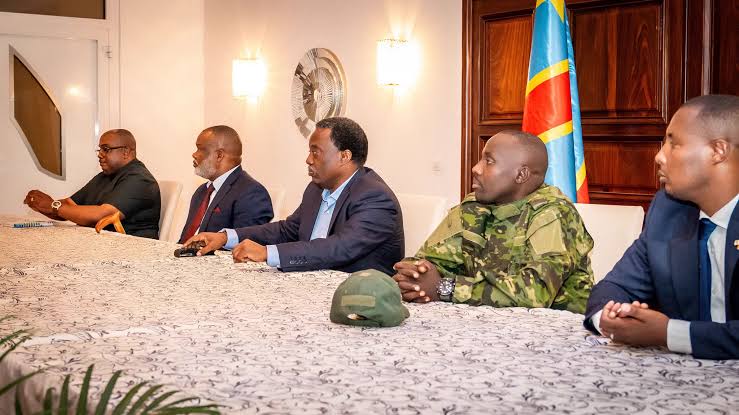
GOMA, Democratic Republic of the Congo , October 13, 2026 – Former Congolese president Joseph Kabila Kabange has been named president of a newly established political-military movement, Le Front pour la Refondation de la Nation (FRN), following a meeting of political and military figures in Goma on October 10–11.
In a political declaration dated October 12, the signatories announced the creation of le FRN, which they said would bring together various resistance forces to pursue what they describe as the political, institutional and national reconstruction of the Democratic Republic of the Congo (DRC).
The declaration also announced the end of the Alliance Fleuve Congo (AFC), stating that the new movement would succeed it.
The announcement marks a significant organizational development among the political and military actors associated with the AFC and the M23 rebellion in eastern Congo.
Kabila appointed president, Nangaa and Bisimwa named vice-presidents
According to the declaration, Kabila will lead the FRN, while Corneille Nangaa Yobeluo and Bertrand Bisimwa have been appointed vice-presidents. Major General Emmanuel Sultani Makenga, identified in the document as chief of staff of the Congo River Alliance’s armed wing, the ARC, will also serve with the rank of vice-president.

Professor Freddy Rukema Kaniki has been designated secretary-general and coordinator of the executive committee, while Benjamin Mbonimpa will serve as deputy secretary-general and deputy coordinator. Désiré Rukomera Rwigema has been appointed permanent secretary of the College of Founders.
The movement says its organizational structure will comprise five bodies: the College of Founders, the Council of the Revolution, the presidency and vice-presidencies, and the Executive Committee, alongside the leadership arrangements outlined in the declaration.
FRN accuses Kinshasa of political and institutional failures
The declaration offers a sweeping criticism of President Félix Tshisekedi’s administration, blaming the country’s multidimensional crisis on what the signatories describe as government irresponsibility, disputed political legitimacy and repeated violations of the Constitution.
The signatories allege that democratic institutions have weakened, judicial independence has deteriorated and political opponents, journalists, military personnel and human rights activists face arbitrary arrests, detention and forced exile.
These accusations reflect the position of the movement’s founders and have not been independently established by the declaration itself.
Security and humanitarian crisis at the centre of the movement’s agenda
On security, the FRN signatories accuse the Tshisekedi administration of pursuing a military strategy at the expense of political negotiations. They allege that the government has relied on foreign forces, mercenaries and armed groups while weakening the Congolese military.
The declaration also raises concerns about violence against civilians, damage to essential infrastructure and continuing insecurity in several parts of the country, including Ituri, Beni and Lubero.
The document further accuses the government of failing to resolve ethnic tensions and discrimination, particularly against Tutsi and Rwandophone communities. It argues that hate speech, contested questions of citizenship and divisions between communities have contributed to mass displacement and hindered the return of refugees.
The allegations concerning military cooperation, ethnic discrimination and attacks on civilians require independent verification.
Economic hardship and corruption cited as reasons for political change
The movement’s founders also criticize the government’s management of national resources, alleging widespread corruption, misappropriation of public funds and the unequal distribution of mineral wealth.
The declaration claims that public debt has exceeded US$18 billion and that more than 80% of the population lives below the poverty line. It also points to unemployment, food insecurity and inadequate access to drinking water, electricity, education and healthcare.
These figures and claims are presented by the signatories and have not been independently verified for this report.
FRN calls for a new political order
The newly formed movement says its objective is to unite resistance forces and bring an end to what it characterizes as tyranny, including through the use of force. It invokes Article 64 of the Congolese Constitution, which concerns the duty of citizens to oppose the seizure or exercise of power in violation of the Constitution.
The declaration also criticizes the stalled peace efforts, including the Doha negotiations, accusing Kinshasa of failing to honour commitments relating to a ceasefire and the release of prisoners.
The FRN says it seeks a broader political settlement rather than simply replacing one governing faction with another. Its stated ambitions include rebuilding state institutions, strengthening justice, guaranteeing citizenship rights, distributing national wealth more equitably, promoting national reconciliation and facilitating the dignified return of refugees and political exiles.
It also calls for greater provincial participation in decisions affecting the country’s future.
What the announcement means for the DRC
The establishment of the FRN under Kabila’s leadership, together with the declared dissolution of the AFC, signals an attempt by the signatories to consolidate their political and military structures under a new banner.
However, the declaration alone does not establish how the new movement will operate, how its leadership will function in practice or whether its stated objectives will translate into a viable political settlement.
The announcement also raises questions about the future of the AFC/M23 alliance, the prospects for negotiations and the implications for efforts to restore security in eastern Congo.
For now, the FRN has presented itself as an alternative to the current political order in Kinshasa, calling on Congolese citizens across political, ethnic and regional lines to join what it describes as a national refoundation project.
The declaration concludes with a stark warning: “Il y a péril, ne pas agir c’est trahir” — “The country is in danger; to fail to act is to betray it.”
Source: Political declaration of the Front for the Refoundation of the Nation (FRN), signed in Goma on October 12, 2026.