

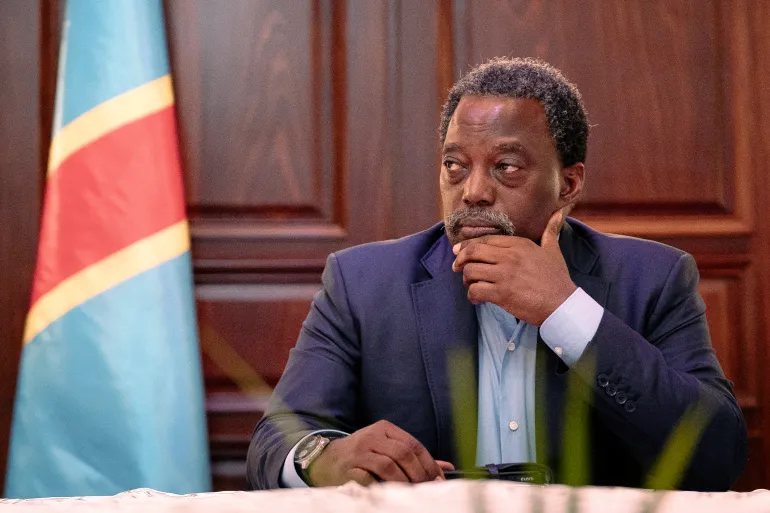
GOMA – Former Democratic Republic of Congo (DRC) President Joseph Kabila has emerged as the leader of a new political-military coalition, the Front pour la Refondation de la Nation (FRN), in a move that puts a former head of state squarely at the centre of the challenge to President Félix Tshisekedi’s government.
The FRN was unveiled in Goma on October 12, 2026, and presented as the successor to the Alliance Fleuve Congo (AFC), the political wing allied with the M23 rebels. Familiar faces remain in key positions: Corneille Nangaa and Bertrand Bisimwa are among its senior political figures, while Sultani Makenga keeps control of the military command.
That continuity suggests a restructuring of the existing alliance under new leadership rather than the dissolution or overhaul of its armed forces.
From regional rebellion to national project
The most visible shift is political. By placing Kabila at its head, the coalition is trying to recast a movement rooted in eastern Congo as a national force. His long years in power give him potential links to former officials, provincial networks and security contacts far beyond the territory AFC/M23 currently holds.
Whether those links turn into real support is another matter. Writing in The New Times, veteran diplomat Amb. Joseph Mutaboba cautioned that potential connections should not be mistaken for loyalty, noting that a former president’s profile brings visibility but cannot replace the consent of Congolese citizens.
The rebrand also poses questions for AFC/M23’s original agenda. Issues such as the protection and citizenship rights of Congolese Tutsi, the return of refugees and the security of vulnerable communities will need a clear place within the broader national programme, rather than being traded away in a contest for power in Kinshasa.
Observers say the coalition’s staying power will depend on whether its members, who may disagree on reform, military integration and decentralisation, can agree on a common programme and a chain of command able to enforce it.
Pressure on Kinshasa
For the government, the conflict now looks less like a purely regional dispute and more like a domestic struggle over power and governance. Kinshasa had previously accused Kabila of backing the AFC/M23 coalition, according to Reuters, a charge he denied. His new public role is likely to be cited by the government as vindication, though analysts warn it does not automatically prove every earlier claim, nor does it settle separate questions about foreign involvement.
How the authorities respond may shape the coalition’s growth. Treating every critic or former Kabila ally as a rebel risks pushing more people toward the opposition, while protecting peaceful political space and addressing legitimate grievances could limit the FRN’s appeal.
The coalition, too, is under scrutiny. At the launch, FRN adviser Claude Ibalanky listed the use of force among the movement’s possible means of action, a statement that has raised concern about the protection of civilians.
What it means for the Doha talks
The announcement complicates ongoing peace efforts. Negotiations in Doha were conducted with AFC/M23, and mediators must now establish who speaks for the new organisation, whether the current delegation keeps its mandate, whether Kabila holds final authority, and whether the military command can enforce a ceasefire across its ranks.
A framework is already in place. The Doha Framework was signed on November 15, 2025, and a joint statement in August 2026 reaffirmed both sides’ commitment to it, covering implementation, verification and outstanding negotiations. Analysts argue the FRN’s arrival should prompt clarification within that process rather than a fresh start, with both the coalition and Kinshasa asked to restate their commitments on ceasefire arrangements, humanitarian access and civilian protection.
There are also concerns that widening the talks to national governance questions could sideline the peaceful opposition and civil society, rewarding those who carry weapons with the most political attention.
Regional obligations remain
For Rwanda and the Great Lakes region, the new coalition does not change existing obligations. The June 27, 2025 peace agreement between the DRC and Rwanda includes the neutralisation of the FDLR, the disengagement of forces and the lifting of Rwanda’s defensive measures. These commitments rest with the signatories and are unaffected by a change of name or leadership within a Congolese coalition.
The African Union and regional leaders are being urged to take the diplomatic lead in clarifying the FRN’s intentions and coordinating with existing mediators, while international partners are called on to apply consistent, evidence-based standards to all parties.
What to watch
Key signs in the coming weeks will include whether the FRN gains support outside eastern Congo, whether notable defections follow, whether its leadership holds together, and, most importantly, where it stands on existing peace commitments.
Three scenarios are possible: a more authoritative negotiating partner able to deliver a deal, a dangerous escalation, or internal splits among leaders united mainly by their opposition to Tshisekedi. For now, the political stakes have clearly risen, but no shift in the military balance has yet been demonstrated.
For Kabila, the test is personal as well as political. Having led the country for many years, he will be expected to explain what his “refoundation” would change in how Congo is governed, and how it would protect the civilians who have borne the cost of decades of conflict.
This report draws on reporting and analysis first published by The New Times (Rwanda).