

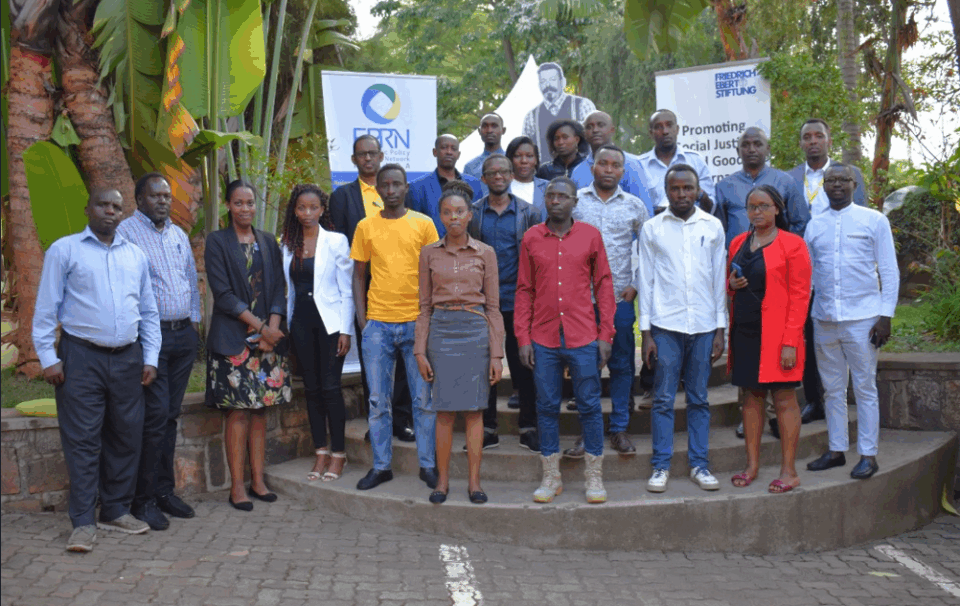
Twenty-five specialized journalists from various media houses in Rwanda are being trained on how to effectively report on economy, trade and regional integration. This function is in line with the East African Community (EAC) mission to widen and deepen economic, political and social development in order to improve the welfare of the region’s citizens.
It is an intensive training on economy trade and regional integration reporting, which will be done under a partnership between Friedrich Ebert Stiftung [FES] and the Economic Policy Research Network [EPRN] operating in Rwanda. In that training that started officially on 09 September, 2022, once per month, there will be one session called Friday breakfast for journalists and it will be done through six months.
“The main reason of this training is to extend a program that aims at bridging the harmonization, exchange and collaboration between the journalists and us so as to build their capacity in reporting stories related to economy,” said Prof. Herman Musahara, one of the experts.
Trainees expressed their gratitude of having been selected for this training. They said they expect skills that will enable them to report more accurate stories based on the economy and the integration of specific EAC member states.
“Currently, the DRC [characterized by frequent insecurity] has joined the EAC. I will cover a story on how insecurity and diplomatic crisis among EAC member states, are affecting trade and integration in this economic bloc,” said Pierre Claver Niyonkuru, a reporter of the Voice of America.
Trainers are experts in the economic fields and expert journalist familiar to the economic trade and regional integration from EPRN network while trainees are journalists interested in reporting on the matter.

According to Adjabu Corneille Twagirayezu who is in charge of Management of Relationship and Partnership at EPRN, the reason they chose to train journalists in the economic and trade reporting is that mainly Rwandan journalists are not interested in this subject. “Most of them found it boring. So, our target is to help them make accurate and balanced economy related stories and impart them with the capacity to decode it to the population” he added.
The training logistics are sponsored by FES while EPRN provides with capacity building.

EPRN is a non-Governmental organization whose mission is to contribute to the evidence based economic policy making by providing high quality research, building and creating networking opportunities; while FES is the oldest political foundation in Germany with a rich tradition in social democracy, dating back to its creation in 1925.
The foundation owes its formation and its mission to the political legacy of its namesake Friedrich Ebert, the first democratically elected German President.
In their attributions among others, they connect people and their ideas to form networks of Social Democracy, working with a wide range of partners on forward-looking projects – at the local, national and global levels.


