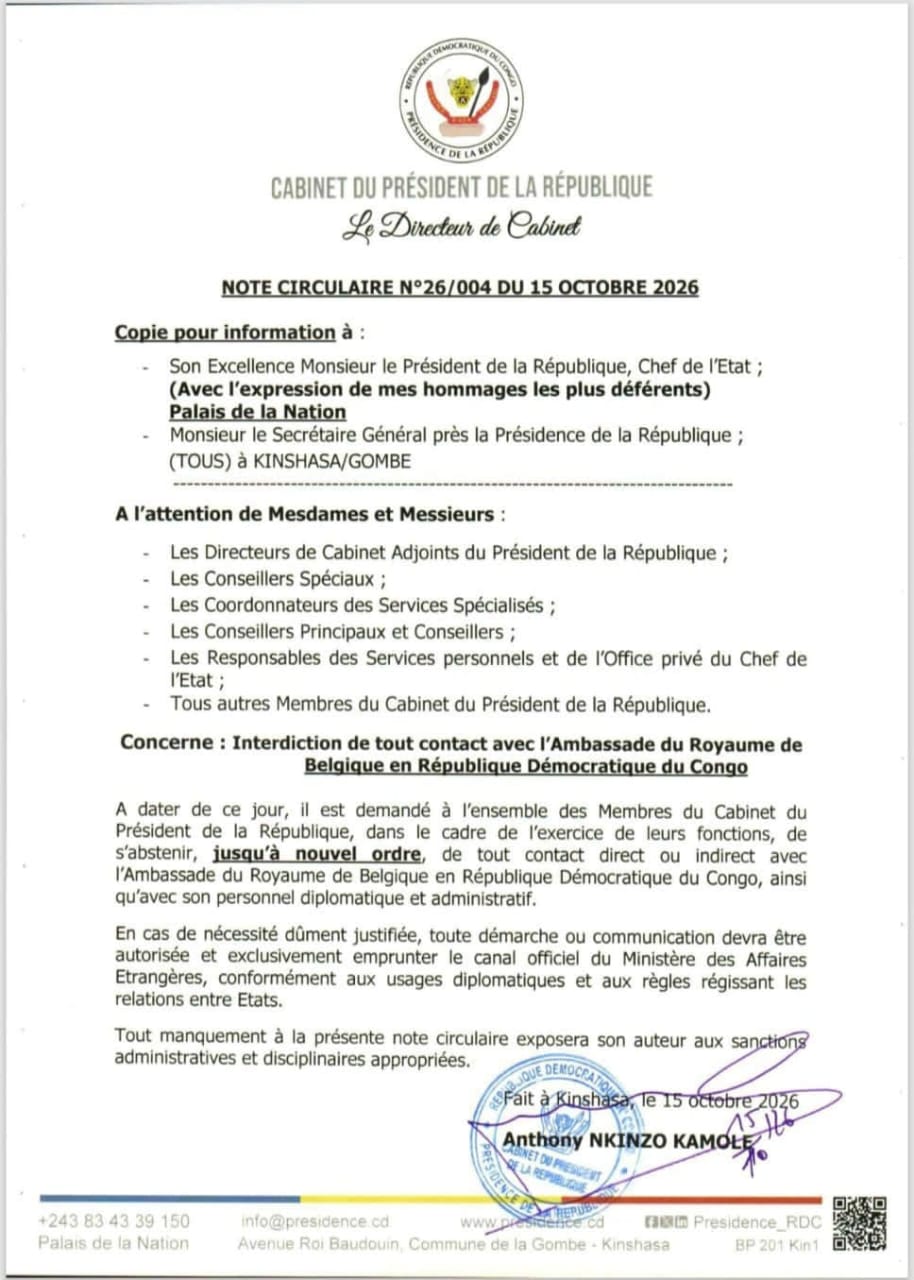

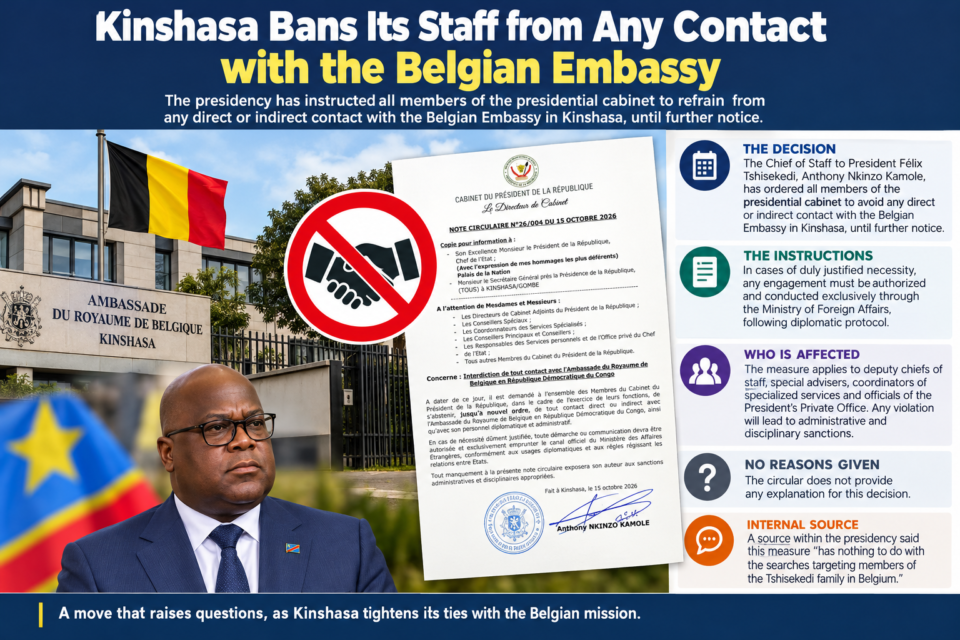
The Chief of Staff to President Félix Tshisekedi, Anthony Nkinzo Kamole, has prohibited all members of the presidential cabinet, “until further notice,” from having any direct or indirect contact with the Embassy of the Kingdom of Belgium in the Democratic Republic of the Congo (DRC), as well as with its diplomatic and administrative staff.
In a circular dated 15 October 2026, he specified that, in cases of duly justified necessity, any such engagement must be authorized and conducted exclusively through the Ministry of Foreign Affairs, in accordance with diplomatic protocol.
The measure applies to deputy chiefs of staff, special advisers, coordinators of specialized services, and officials of the President’s Private Office. Any violation will expose the offender to administrative and disciplinary sanctions.
The circular does not provide any reasons for the measure.
An internal source stated that “this measure has nothing to do with the searches targeting members of the Tshisekedi family in Belgium.”
The circular was issued a day after Belgian federal police carried out coordinated searches on Wednesday, 14 October 2026, at properties in Brussels and several municipalities in Flemish Brabant and Walloon Brabant linked to relatives and associates of President Tshisekedi, as part of an investigation into suspected money laundering. According to the Belgian Federal Prosecutor’s Office, several dozen police officers took part in the operations.
The prosecutor’s office declined to identify the properties searched or to say whether anyone had been questioned or any assets seized, citing the secrecy of the investigation and the presumption of innocence. The probe reportedly targets family members who hold Belgian nationality rather than the President himself, who enjoys immunity as a sitting head of state. Earlier media reports named First Lady Denise Nyakeru Tshisekedi, several of the President’s brothers and two of his children among those cited in the complaints.
The case stems from complaints filed in July 2025 by civil society organizations from Katanga and four former executives of Gécamines, the Congolese state-owned mining company. The complainants allege corruption, embezzlement of public funds and money laundering linked to mining activities in the provinces of Haut-Katanga and Lualaba, claiming that the proceeds were moved through financial accounts and assets in Belgium.
A spokesperson for the Congolese presidency declined to comment on the searches. The investigation adds to the pressure on Kinshasa, which is already contending with an armed rebellion in the east of the country and a deadly Ebola outbreak. The DRC is the world’s leading producer of cobalt, a critical mineral used in rechargeable batteries, but its mining sector has long faced allegations of corruption and a lack of transparency in how revenues are managed.