

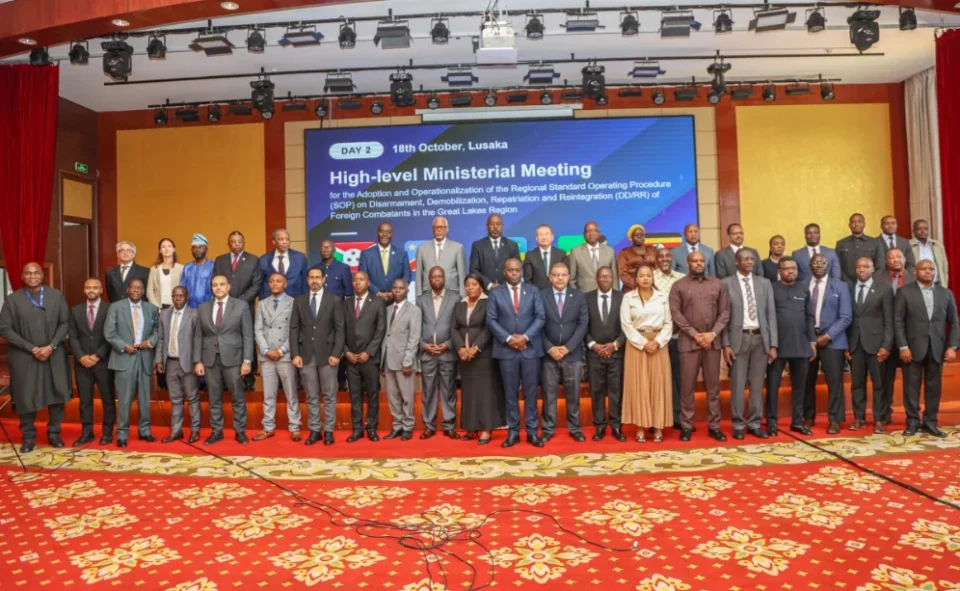
Five countries in the Great Lakes region have agreed on a common set of draft rules for dealing with foreign armed fighters in the region. The rules would guide how these fighters are disarmed, demobilised, sent home and helped back into civilian life.
The agreement was reached at a ministerial security meeting in Lusaka, Zambia, on Sunday, October 18. The countries involved belong to the Contact and Coordination Group: Burundi, the Democratic Republic of Congo, Rwanda, Uganda and Tanzania. They were represented by their defence and foreign affairs ministers, or by officials sent on their behalf. Defence Minister Juvenal Marizamunda headed Rwanda’s delegation.
From technical review to ministerial approval
The ministers did not start from scratch. A day earlier, on October 17, technical experts met to examine the draft procedures and prepare them for the ministers. The document is a set of Standard Operating Procedures (SOPs). The ministers’ approval does not make it final. The draft will now go to the Heads of State, who will review it and decide whether to formally adopt it.
The Lusaka meeting was the last in a series of regional defence meetings that week. The series opened on October 14 with the fourth ordinary session of the Specialized Committee of Defence Experts. The Chiefs of Defence Forces held their 20th meeting on October 15, and the Ministers of Defence held their 20th meeting on October 16.
Why it matters
Foreign armed groups have operated in eastern DR Congo for decades. They are one of the main causes of mistrust between neighbouring countries. For Rwanda, the biggest concern is the FDLR. This is an armed group active in eastern DRC that was implicated in the 1994 genocide against the Tutsi.
The Lusaka agreement comes as other peace efforts are also underway. On 28 July, Kinshasa signed a protocol with the FDLR on disarming, demobilising and cantoning its fighters, in line with the Washington Accords. However, a UN Secretary-General’s report notes that the DRC and Rwanda interpret this protocol differently.
The new procedures are the result of earlier regional work. At a working session in Kampala, participants set out to develop generic SOPs for the repatriation, reinsertion and reintegration of ex-combatants from foreign armed groups, including foreign fighters who had joined local armed groups. pddrcs
Before the Lusaka talks, observers said that trust and verification would be a major challenge for the ministers. They also argued that military action alone cannot solve the armed groups problem, and that strong community reintegration and economic development programmes are needed alongside it. streamlinefeedstreamlinefeed
What comes next
The draft is now with the Heads of State. Their decision will determine whether the region gets a shared and binding framework for handling foreign combatants. If they adopt it, the next test will be putting it into practice. Countries will need to agree on who identifies and verifies fighters, how fighters are returned to their home countries, and how they are supported to rebuild their lives without going back to the bush.